




 Belgium -
English
Belgium -
English

What you need to know as a physiotherapist about shockwave therapy for knee osteoarthritis
An innovative approach to pain reduction and functional improvement

Everyone wants to grow old, but no one wants to feel old. A well-functioning body makes a huge difference. The world's population is ageing rapidly, and with it the number of chronic conditions such as knee osteoarthritis is rising. Already, around one in three people over the age of 60 worldwide suffer from symptomatic knee osteoarthritis. At the same time, less healthy lifestyles and poorer dietary habits are contributing to an increasing number of cases among younger people as well.
There is currently no medication that can cure or prevent this condition, although invasive joint replacement surgery remains an option. However, it is often best to postpone surgery for as long as possible, as an artificial knee typically lasts only 15 to 20 years. Postponing surgery can help reduce the risk of needing revision procedures later in life. This is where the physiotherapist plays a crucial role. Through education, targeted exercise therapy and emerging new treatment methods such as shockwave therapy, pain can be reduced and functional abilities improved – potentially helping to postpone the need for surgical intervention.
What is knee osteoarthritis and what are its consequences?
Knee osteoarthritis is a degenerative joint disease that causes the progressive breakdown of joint cartilage. There are two types of knee osteoarthritis: primary and secondary. Primary osteoarthritis develops without a clear underlying cause. Secondary osteoarthritis occurs as a result of abnormal force concentration on the joint (trauma) or due to underlying joint or cartilage disorders, such as rheumatoid arthritis (RA).
The Kellgren and Lawrence classification of knee osteoarthritis
The Kellgren and Lawrence classification[ii] is a commonly used method for grading the severity of osteoarthritis. It distinguishes five stages of the condition:
- Grade zero: no joint space narrowing or reactive changes.
- Questionable narrowing of the joint space and possible early osteophyte formation
- Clear osteophytes with possible narrowing of the joint space
- Multiple osteophytes, clear narrowing of the joint space, sclerosis, possible bony deformity
- Large osteophytes, clear narrowing of the joint space, severe sclerosis and definite bony deformity
Possible symptoms of knee osteoarthritis:
Common symptoms of knee osteoarthritis include:
- Knee pain that worsens with weight bearing or activity
- Stiffness and swelling of the knee
- Pain after prolonged sitting or resting
- Joint instability
- Reduced quality of life due to pain and limited mobility
These symptoms can lead to reduced activity levels and limited participation in work, leisure, social activities and sports.[iii] They do not often lead to a complete inability to work, but adjustments to the work environment or working hours are often necessary.[iv]
Treating knee osteoarthritis without surgery
The initial approach to knee osteoarthritis is often conservative. This may include braces, painkillers, corticosteroid injections and, last but not least, education and exercise therapy provided and supervised by a physiotherapist.[v]
When these treatments no longer provide sufficient relief, a knee prosthesis may be considered. As the number of people affected by knee osteoarthritis continues to grow, the demand for knee prostheses is increasing, along with healthcare costs. A knee prosthesis can cost up to €17,000. Rehabilitation may take up to a year, and revision surgery might be necessary after 15 to 20 years. So the longer the operation can be postponed, the better. Fortunately, scientific research suggests that physiotherapists now have a promising additional, non-invasive treatment option in shockwave therapy, which may help reduce pain and improve function.
Shockwave therapy for knee osteoarthritis in the literature
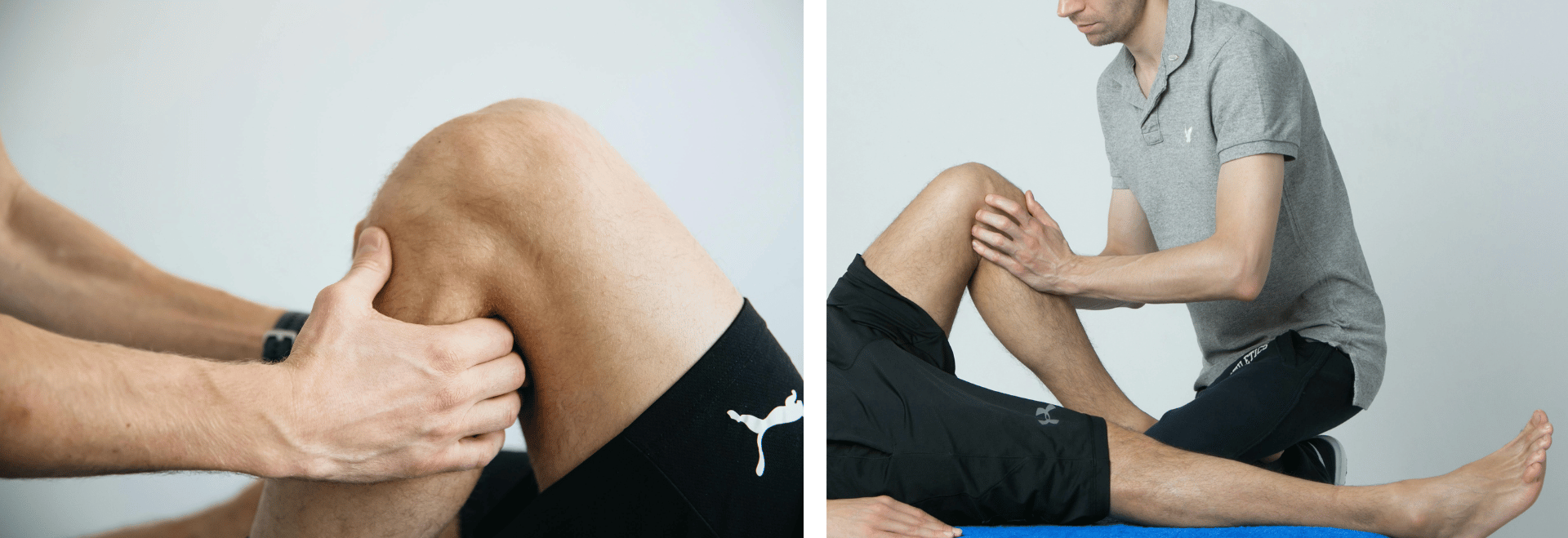
Extracorporeal shockwave therapy (ESWT) has recently emerged as a non-invasive physiotherapy intervention for treating osteoarthritis. During shockwave therapy, short, intense sound waves stimulate the body's natural repair processes, which can help reduce pain and support tissue healing. Shockwave therapy is generally considered safe, easy to use and well-tolerable, making it an accessible treatment option within a physiotherapy practice.
Clinical studies: effect of shockwave therapy on knee osteoarthritis
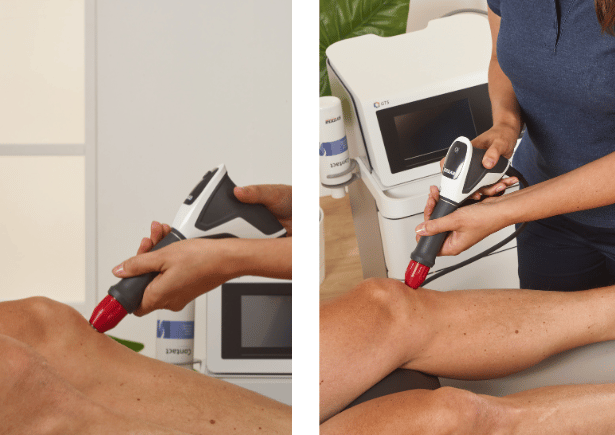
In 2013, researchers first investigated the impact of shockwave therapy on knee osteoarthritis. They reported positive outcomes and found no adverse effects associated with this type of intervention.[vi]
Since then, a growing number of clinical studies have attempted to evaluate the efficacy of ESWT on the progression of osteoarthritis and cartilage degeneration:
- Ediz et al. (2018) investigated the effect of ESWT on primary medial knee osteoarthritis in older adults. They reported that shockwave therapy led to pain reduction and functional and radiologically visible improvement without significant complications. These improvements were still present after one year .[vii]
- Lizis et al. (2017) compared shockwave therapy with exercise therapy for knee osteoarthritis and found that shockwave therapy resulted in a greater and statistically significant improvements in the WOMAC scores and ROM than exercise therapy.[viii]
- Romeo et al. (2014) reported not only beneficial effects on the actual joint cartilage with an improvement in the hyaline cartilage structure and a reduced joint stiffness characteristic of this condition, but also positive effects from the simultaneous treatment with rESWT of the surrounding tendons, muscles and ligaments.[ix]
Systematic reviews and meta-analyses on shockwave therapy for knee osteoarthritis
Several systematic reviews and meta-analyses have examined the use of ESWT, including radial shockwave therapy, for knee osteoarthritis. While methodologies vary across studies, the evidence generally supports the potential benefits of ESWT in reducing pain and improving function for patients with knee osteoarthritis:
- Cao et al. (2024) conducted a systematic review comparing seven different non-pharmaceutical therapies for the treatment of knee osteoarthritis (shockwave, laser, acupuncture, ultrasound, nerve stimulation, minimally invasive puncture, exercise therapy) across 24 RCTs. Shockwave therapy was found to be most effective for pain and functional outcomes, while laser therapy showed better results than shockwave therapy on the mobility subscale. Of course, further rigorous and well-designed, randomised, controlled studies are needed to confirm these findings.[x]
- Research by Liao et al. (2024) suggests that ESWT may be more effective than other treatment options, such as intravenous prostacyclin, bisphosphonates, corticosteroid injections, hyaluronic acid injections, platelet-rich plasma injections and traditional physiotherapy.[xi]
Shockwave therapy for knee osteoarthritis in practice
In order to apply shockwave therapy effectively, it is important to identify which patients are most likely to benefit from this treatment. While earlier studies focussed primarily on grade 1 to grade 3 knee osteoarthritis, recent research shows promising results, even for patients with grade 4 osteoarthritis [xii].
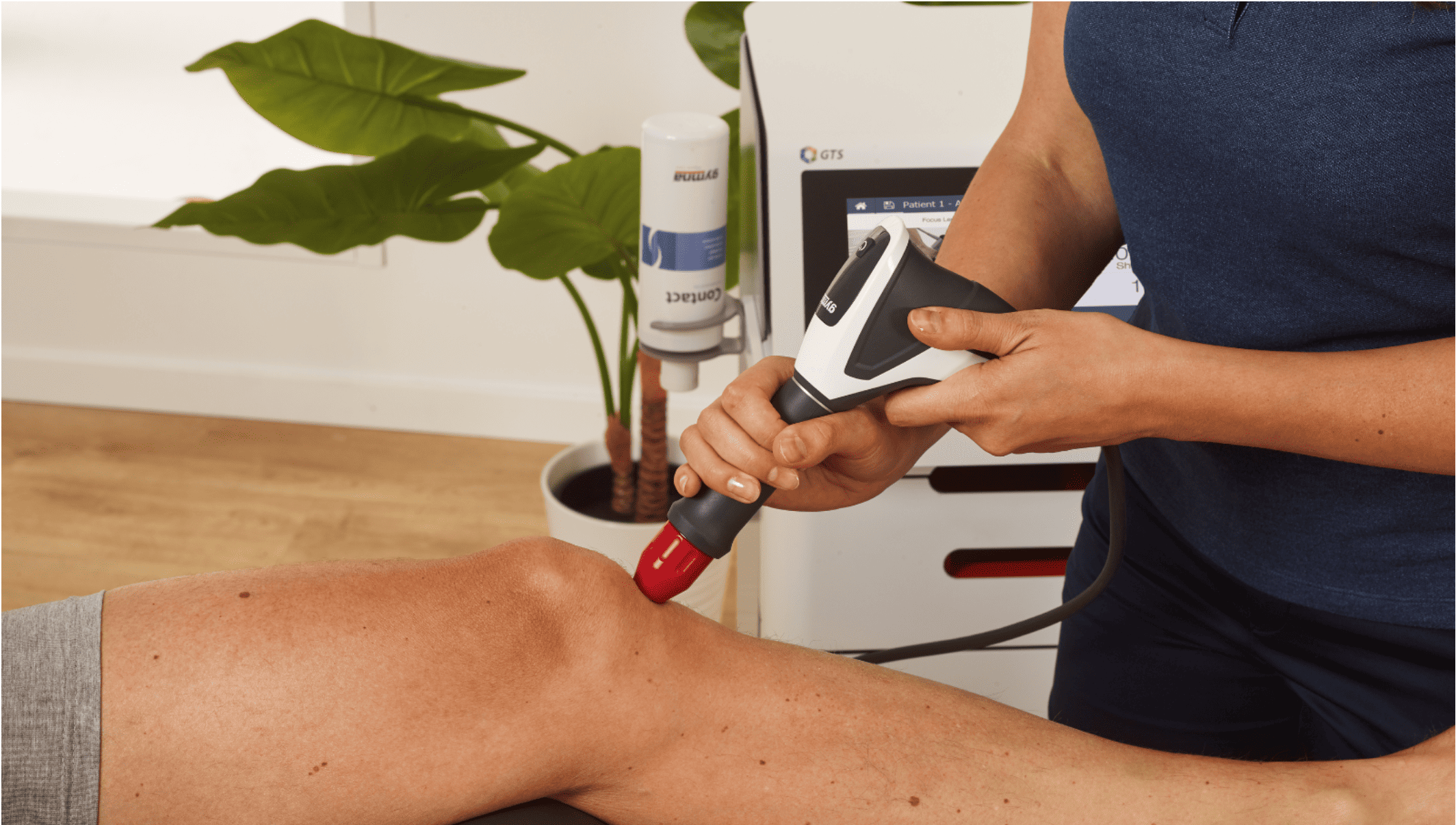
Determining the correct dosage can be complex if relying solely on the literature. Fortunately, the Gymna ShockMaster simplifies this process. Equipped with the so-called Guided Therapy System, or GTS, it provides practical treatment suggestions for a range of conditions, including osteoarthritis. These treatment suggestions are based on the latest scientific insights from RCTs as well as the experience of expert shockwave therapists and are updated every two years to reflect best practice.
Discover more about our Guided Therapy System
Shockwave therapy with the Guided Therapy System All treatment suggestions in GTS contain a set of parameters with a recommended pressure (bar), frequency (number of shocks per second) and number of shocks, possibly in multiple sequences. These sequences represent the successive treatment steps in a single treatment, ensuring that the patient receives a comprehensive treatment and optimizing the recovery process. The same sequence is followed for each treatment. In addition, each treatment suggestion comes with a detailed description, which states, for example, that you start with low pressure and then gradually build up to a certain maximum pressure (which varies per treatment suggestion). Based on the therapist’s assessment of the status of the patient’s current condition, the physiotherapist determines the appropriate starting pressure for the next treatment. Some settings may need to be adjusted individually, which is the responsibility of the physiotherapist. , Even with pre-programmed settings, clinical reasoning is essential to ensure safe and effective treatment for each patient. |
Stand out from other practices with innovative shockwave therapy for knee osteoarthritis
Shockwave therapy offers physiotherapists an innovative solution for treating knee osteoarthritis. This non-invasive therapy may help reduce pain, improve function and enhance patients’ quality of life. While scientific research into shockwave therapy is still relatively recent, the existing evidence is promising when it comes to the effectiveness of this treatment modality. Despite this, many physiotherapists remain unaware of its benefits, which means that the therapy is still underutilised. This creates an excellent opportunity for physiotherapy practices looking to differentiate themselves and offer innovative care.
Would you like to offer shockwave therapy in your practice?
Shockwave therapy is not limited to knee osteoarthritis. There are may be other potential applications that you may not yet be aware of. For example, read our other blogs about:
shockwave therapy in general shockwave therapy for trigger points
shockwave therapy for tennis elbow shockwave therapy for children with spasticity
shockwave therapy for supraspinatus tendinopathy or Achilles tendinopathy
If you have any questions about our shockwave equipment or are considering investing in a device for your practice, please feel free to contact us without obligation.
[i] https://reumanederland.nl/nieuws/europese-onderzoekers-slaan-handen-ineen-voor-tsunami-van-artrose
[ii] Kohn, M. D., Sassoon, A. A., & Fernando, N. D. (2016). Classifications in Brief: Kellgren-Lawrence Classification of Osteoarthritis. Clinical orthopaedics and related research, 474(8), 1886–1893. https://doi.org/10.1007/s11999-016-4732-4
[iii] Bijlsma, J. W., Berenbaum, F., & Lafeber, F. P. (2011). Osteoarthritis: an update with relevance for clinical practice. Lancet (London, England), 377(9783), 2115–2126. https://doi.org/10.1016/S0140-6736(11)60243-2
[iv] Everaert C. (2014). Gevolgen van heup- en knieartrose voor arbeidsparticipatie. Journal of Occupational and Insurance Medicine, 22 (4), 160-161.
[v] https://richtlijnendatabase.nl/richtlijn/artrose_in_heup_of_knie/startpagina_-_heup-_of_knieartrose.html
[vi] Zhao, Z., Jing, R., Shi, Z., Zhao, B., Ai, Q., & Xing, G. (2013). Efficacy of extracorporeal shockwave therapy for knee osteoarthritis: a randomised controlled trial. The Journal of surgical research, 185(2), 661–666. https://doi.org/10.1016/j.jss.2013.07.004
[vii] Ediz, L. & Özgökçe, M. (2018). Effectiveness of extracorporeal shock wave therapy to treat primary medial knee osteoarthritis with and without bone marrow oedema in elderly patients. Turk Geriatri Dergisi, 21, 394-401. https://geriatri.dergisi.org/uploads/pdf/pdf_TJG_1062.pdf
[viii] Lizis, P., Kobza, W., & Manko, G. (2017). Extracorporeal shockwave therapy vs. kinesiotherapy for osteoarthritis of the knee: A pilot randomised controlled trial. Journal of back and musculoskeletal rehabilitation, 30(5), 1121–1128. https://doi.org/10.3233/BMR-169781
[ix] Romeo, P., Lavanga, V., Pagani, D., & Sansone, V. (2014). Extracorporeal shock wave therapy in musculoskeletal disorders: a review. Medical principles and practice: international journal of the Kuwait University, Health Science Centre, 23(1), 7–13. https://doi.org/10.1159/000355472
[x] Cao, S., Zan, Q., Wang, B., Fan, X., Chen, Z., & Yan, F. (2024). Efficacy of non-pharmacological treatments for knee osteoarthritis: A systematic review and network meta-analysis. Heliyon, 10(17), e36682. https://doi.org/10.1016/j.heliyon.2024.e36682
[xi] Liao, P. C., Chou, S. H., & Shih, C. L. (2024). A systematic review of the use of shockwave therapy for knee osteoarthritis. Journal of orthopaedics, 56, 18–25. https://doi.org/10.1016/j.jor.2024.04.020
[xii] Cp A, Jayaraman K, Babkair RA, Nuhmani S, Nawed A, Khan M, Alghadir AH. Effectiveness of extracorporeal shock wave therapy on functional ability in grade IV knee osteoarthritis - a randomized controlled trial. Sci Rep. 2024 Jul 17;14(1):16530. doi: 10.1038/s41598-024-67511-x. PMID: 39020015; PMCID: PMC11254909.
Share this article


 +32 89 510 532
 info@gymna.com


